
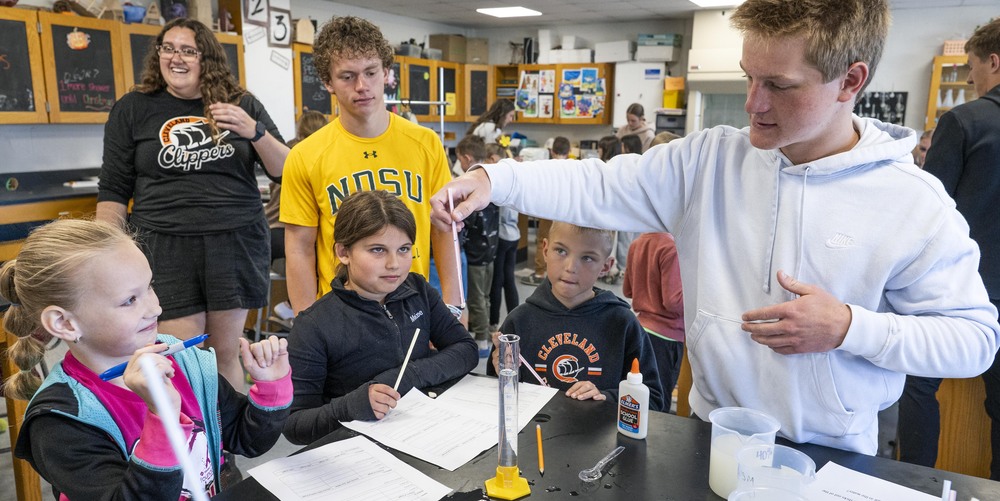
Since Brooke Vogel’s first and second-grade classroom is directly below Anneliese Johnson’s high school science lab, her students sometimes hear the faint rumbling of students working above.
The floor-ceiling connection sparked a chat between the two teachers, which led to their idea of having the elementary students make their way upstairs and join high schoolers in a science experiment.
“We just thought it would be a fun collaboration unique to a K-12 building,” Johnson said.
While Johnson chose the junior chemistry class to work with the elementary students, the lesson she selected focused on density, the ratio of a substance’s mass to its volume.
She started the class with an anchor phenomenon, an observable event used to both pique curiosity and provide a continuous path for learning as students do experiments to investigate why the phenomenon occurs.
Johnson showed the students two cans of soda in a water-filled bowl. The diet soda was floating while the regular soda had sunk.
So, aided by the juniors—and learning how to use beakers, graduated cylinders, pipets and scales—the elementary students performed a series of experiments and collected data from them that could help them explain the difference.
“It was fun,” said Carson Lyons, who was helping staff one of the six experiment stations spread around the lab. “The kids were just so glad to be there.”
After finishing their experiments, the students participated in a sensemaking conversation, where the class determined that more sugar in soda adds mass, which causes the can of non-diet soda to sink, provided the volume doesn't change.
“So, ultimately, the goal was to have the first and second graders understand sugar increases density and density affects buoyancy,” Johnson said.
But beyond the immediate lesson, the experiment was an exercise in scientific method.
“It was an opportunity to have them practice science skills like observation, collecting data, and working with lab equipment,” Johnson said.
The physics study was a lesson for the juniors as well, she said.
“Something that I was hoping they would be able to practice through this was helping others make sense of observation, as opposed to just giving an answer to someone's question. This practice helps build critical thinking for both the students, grades one and two in this case, and the teacher, 11th graders in this case.”
Above: Carson Lyons and Caleb Connor help measure the specific gravity of sugar water. Observing is Anneliese Johnson.
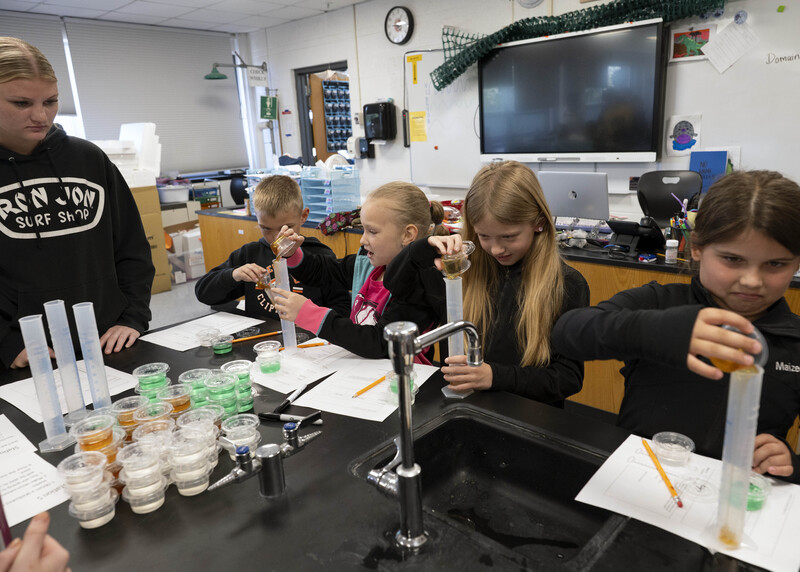 In this station, students compared the buoyancy in water of corn syrup, honey and colored water. On the left is Keira Schipper.
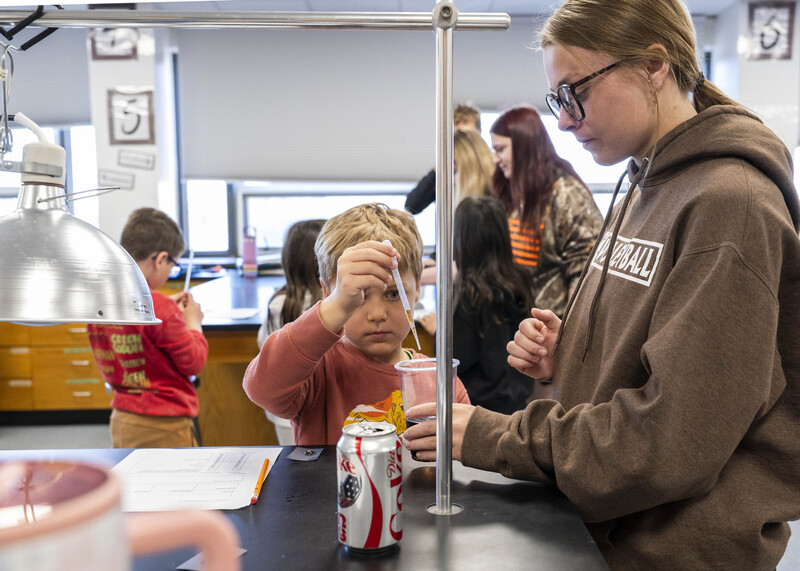 Delaney Thompson helps a student pipet a sample of soda…
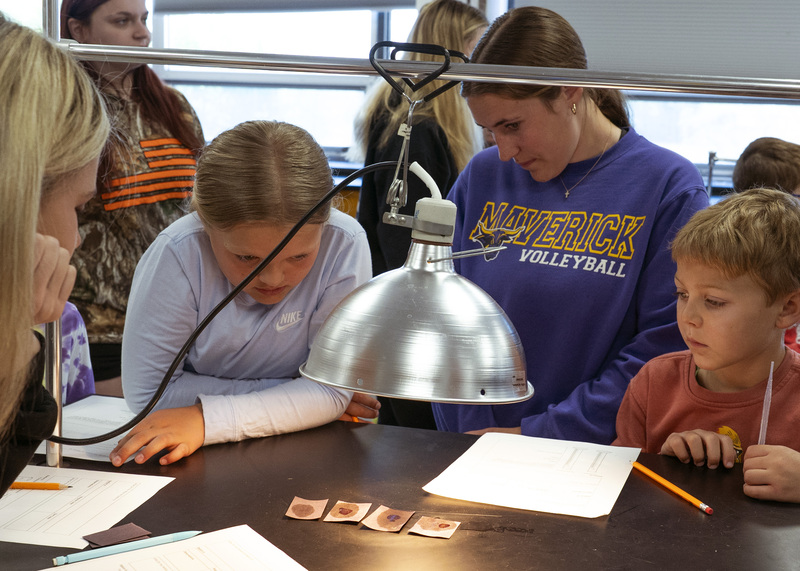 …for drying under a heat lamp to see how much solid remains. Watching is Taylor Wolf.
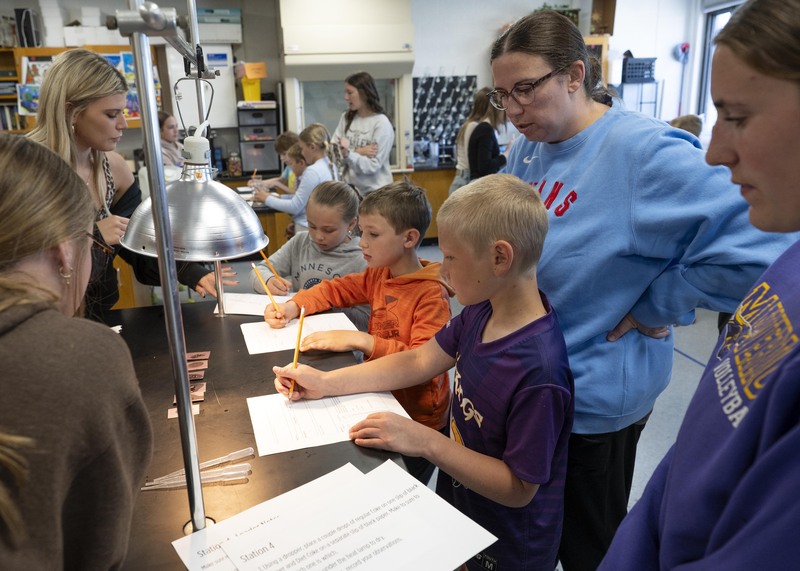 Recording data was part of the study. Here, Liviana Lee, Brooke Vogel and Taylor Wolf guide students as they record the data from the soda sample drying experiment.
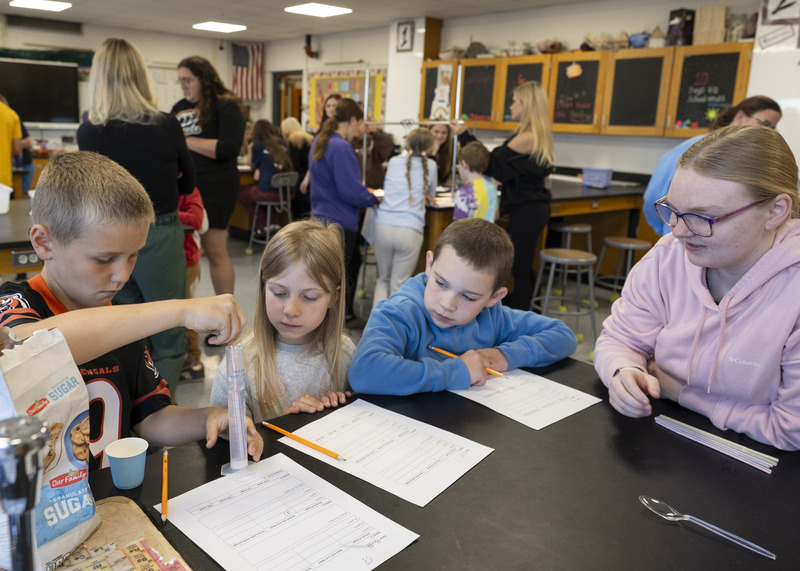 Kylie Poepping watches elementary students add sugar to water in an experiment to see how the addition affects volume.
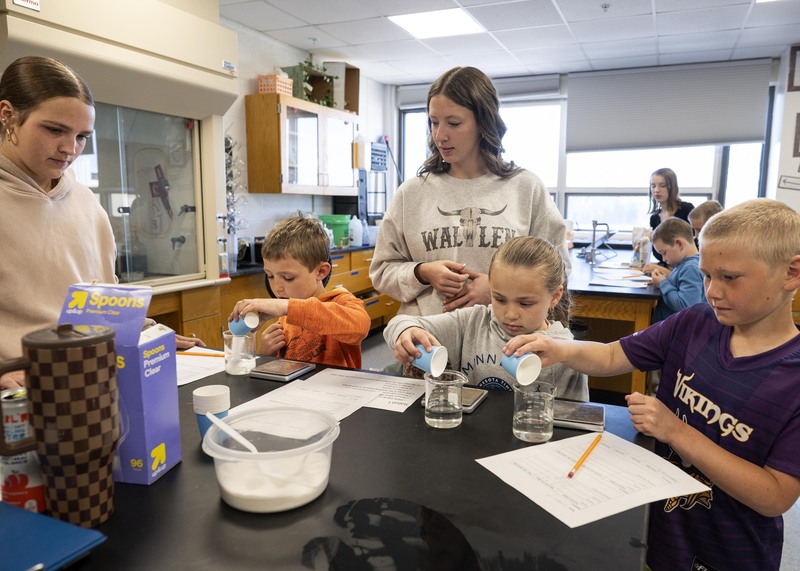 Kaitlyn Flowers and Taylor McCabe assist in an experiment to see how adding sugar to water affects overall weight.
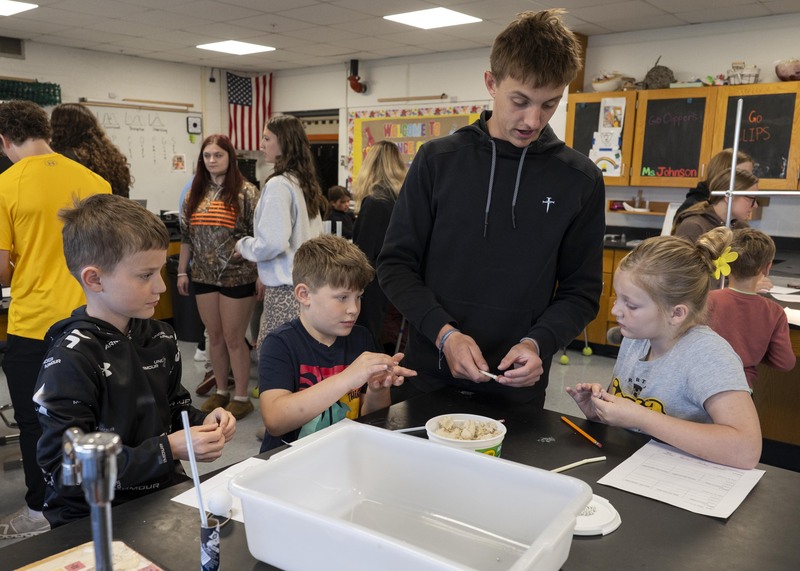 Braeden Smith helps students make hydrometers, instruments used to measure the specific gravity (density) of a liquid relative to water. Operating on the principle of buoyancy, a hydrometer floats higher in denser liquids and lower in less dense ones.
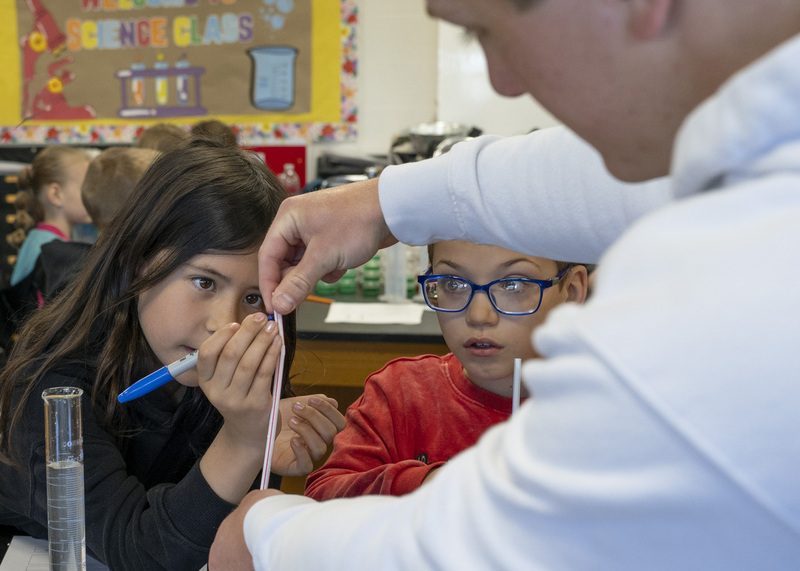 Caleb Connor helps a student mark a hydrometer reading.
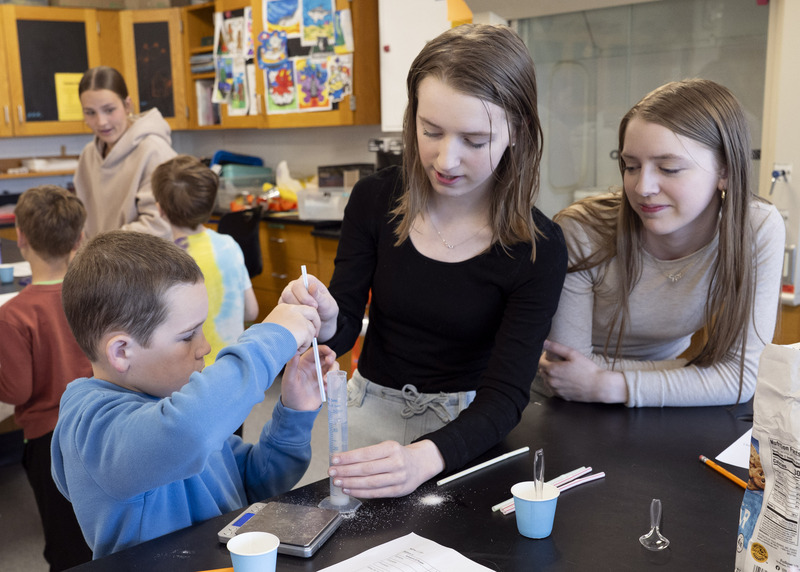 Leia and Norah Ross help a student add sugar to water to see if the addition results in a volume delta.