
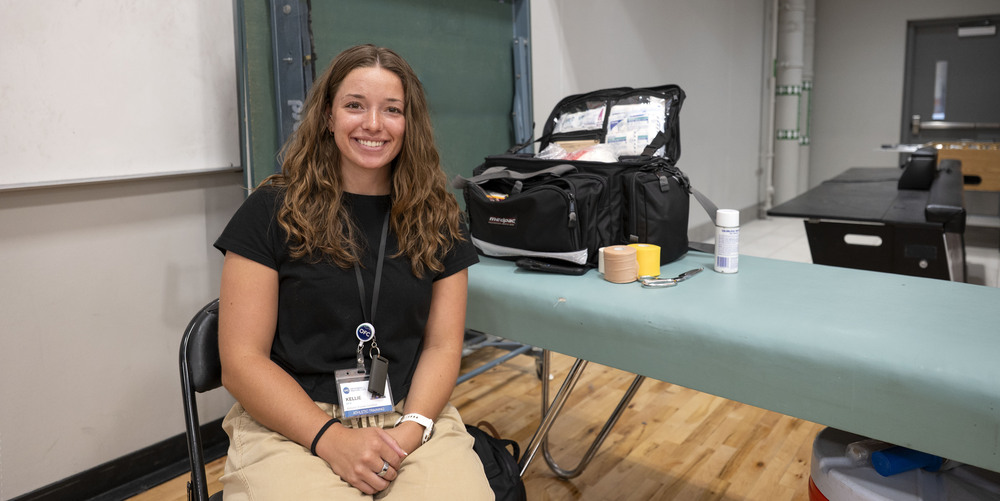
As a high school athlete, Kellie Dallmeyer was on the receiving end of injury diagnosis and treatment when she first learned about the role of athletic trainers.
And, since she loved the competitive environment of sports, she knew she wanted to be involved in athletics as a career. Furthermore, because she was “super intrigued” by all things athletics: anatomy, rehabilitation, strength training, nutrition…choosing a specific profession became obvious.
“Athletic training was the path that combined all of my interests together.”
This fall, contracted through the Orthopaedic & Fracture Clinic (OFC) in Mankato, Dallmeyer took the role of athletic trainer at Cleveland School.
Superintendent Dustin Bosshart said the school board’s decision to have a dedicated athletic trainer came down to what was best for both students and coaches.
“The decision was primarily about student athlete safety and ensuring we have professional expertise on-site to immediately assess injuries. It gives our coaching staff a greater sense of confidence and allows them to focus on coaching rather than the medical side of things.”
Background
Dallmeyer grew up near Washington, Iowa, a city located in the southeast corner of the state.
After graduating from high school there, she earned an undergraduate degree in exercise science from the University of Iowa. While there, she spent two years working with the Iowa men's wrestling team.
“This opportunity really solidified that I was on the right career path, and I had a fantastic mentor who guided me into the athletic training world.”
After her bachelor’s work, it was on to South Dakota State University, where she earned a master’s degree in athletic training. During her time there, she gained experience with several different clinical rotations, including SDSU women's basketball, SDSU women's soccer, SDSU baseball, Brookings High School, Sioux Valley High School, Avera Human Performance Center and Sanford Clinic (family medicine/sports medicine).
Work at CHS
As an OFC employee, Dallmeyer will support all Clipper teams, primarily covering high school but will work with junior high athletes when needed. She will be on hand for all home games as well as away games for football and any section and state tournaments. She will be at nearly all practices unless covering an event for another OFC sponsored school.
“When multiple teams are practicing at the same time, my priority will go to the sport with the higher contact rate,” she said. “So, this fall I will be mainly out at football practices, but in the event volleyball needs help with anything, I will step aside from football and go into the gym. Home events will take priority over practices.”
She said having an athletic trainer on site is becoming more common at the high school setting.
“Athletic trainers can evaluate injuries on site and provide guidance for the athlete to return to play. ATs are trained individuals to provide emergency and first-aid care when those situations arise. Having a medically trained individual to make decisions may take off pressure from the coach staff or other school administrators who may not have as much education in the healthcare field.”
Her duties include injury evaluation, rehabilitation programming, return to play, first aid and emergency care, injury prevention, nutritional guidance, concussion evaluation and management, taping and bracing, patient education, movement analysis, support system, and, when needed, connecting athletes to higher level care.
Communicating with parents or guardians when an athlete is injured will also be an important part of her role.
“When an athlete sustains an injury in a game or practice, the parent or guardian will be notified via phone call from me. Here, I will explain the scenario, make recommendations for the athlete moving forward and answer any questions they may have. Beyond the initial phone call or in-person interaction, I am available by email if any follow-up questions arise. I will be here every step of the way to support your athlete, give them the care they need, and help them return to their activity.
“If an athlete sustains an injury needing more care than I can provide, I will refer them to see one of our providers at Orthopaedic and Fracture Clinic. I will communicate with that provide in advance to let them know of the situation and together we will collaborate to come up with a plan that is best for the athlete.”
But Dallmeyer would like to do her part to prevent injuries from occurring.
“Any individual athlete, coach, or entire team can come see me if they would like help with preventive rehabilitation exercises, stretches, warm-ups, cool-downs, or strength and conditioning planning. Even if the athlete is in a sport that co-ops with another school, I am happy to help.”
When she is not on the sidelines, Dallmeyer enjoys going on walks with her Australian shepherd, Kayda, traveling and hiking in national parks.